

I’ve been in Australia for nearly 4 weeks now and although there are many things about the UK I miss badly – people and places – Geelong in Victoria is lovely, and I am very happy to be here. I still have a role at the University of Portsmouth, not least the co-organisation, with Oren Lieberman, of the AHRA conference Situated Ecologies of Care that I wrote about here. But this semester I will also be running a Masters studio at the University of Melbourne. I haven’t taught a Masters architecture studio for a few years and I am very excited.
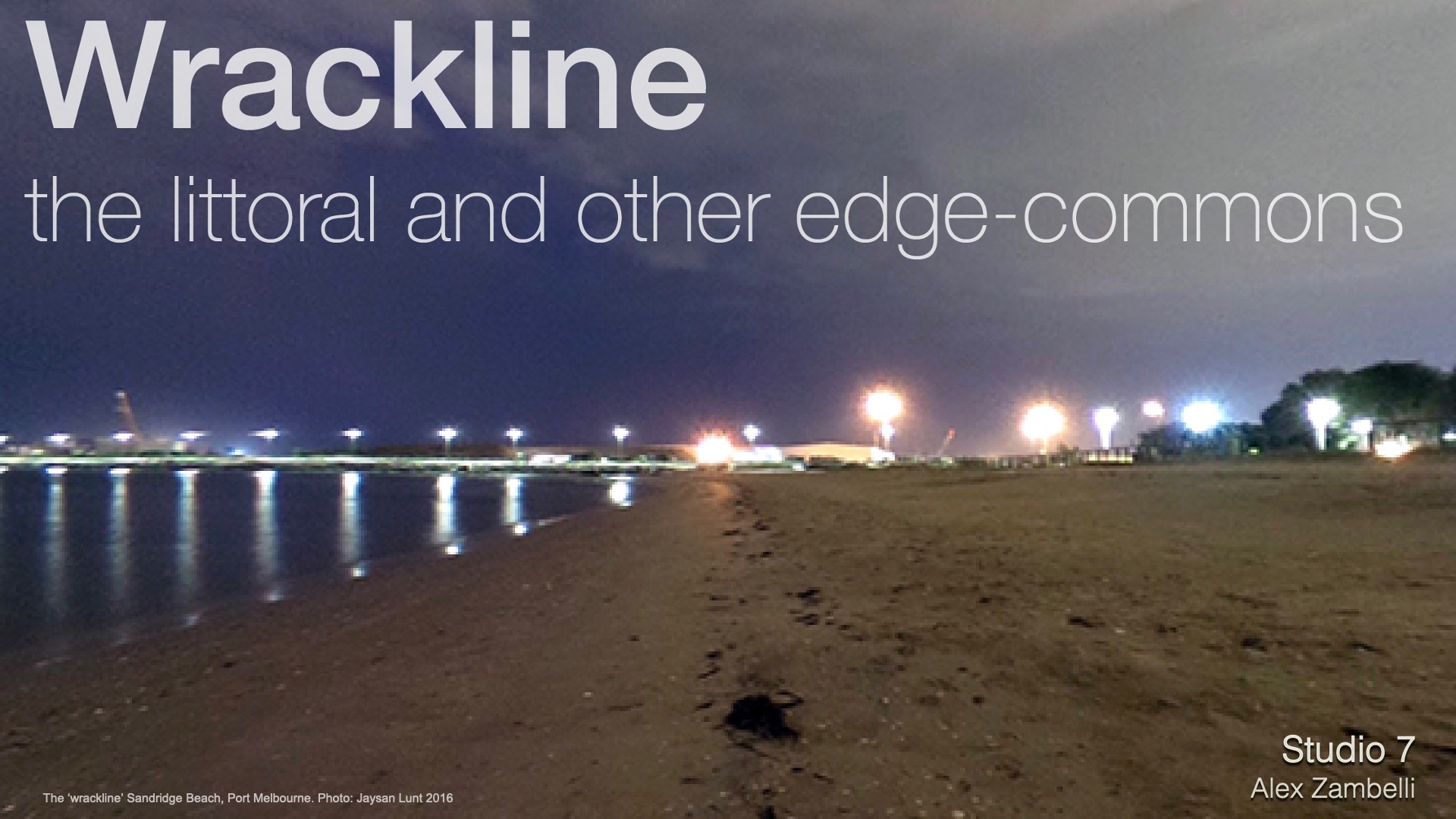
At some point in the depths of the Covid pandemic English folk musician and academic Fay Hield released an astonishing album called Wrackline. Its songs of animism, therianthropy, constraint and release – abandonment even – and other freedoms were powerful antidotes to lockdown claustrophobia. Because amongst other things the wrackline – that fuzzy line of ‘things’ the receding tide leaves behind on the beach – is a place where things ‘end up’ just as I have ended up here (in the nicest possible way!). Bathetically our site (or part of our site) is next to the port in Melbourne where the container with my stuff in it will also end up. In fact my vinyl copy of Wrackline is, as I write, in that container on a ship in the Red Sea on its way from the UK to Melbourne.
The studio brief as issued to my students says both less and more than this version:
Wrackline: The littoral and other edge-commons
Dr Alessandro (Alex) Zambelli
On the land my head is spinning, like the eddies in the water, where the swirling ripples gather.
We must never cross the wrackline, where the water leaves the treasures of the sea to mark the measure.
Round and round we all go dancing, on the shingle in the water where the selkie people gather.
Hield, Fay. 2020. “Swirling Eddies.” In Wrackline. Topic (my transcription of the lyrics).

(How) should we build in the edge – of the land, of Country, of the continent, of the city?
In the English language alone, this terrain has many names; littoral, shore, surf zone, seashore, wrack zone, backshore, coast, foreshore, intertidal zone, nearshore, dune. There are many others. For some this edge is profoundly blurred, perhaps even immaterial, “indigenous people still relate to land that was inundated by sea during the last ice age and regard it as their own … [they] make no distinction between land and sea.”[1]
In our studio we will think of this shifting, blurred threshold as an edge-common or commons.[2] More than this, at the continental scale for us the city is the wrackline.

“The historic meaning of the term ‘common land’ and the modern meanings of the terms ‘common’, ‘commons’, and, yet more recently, ‘commoning’, conceal a multitude of starkly differing senses. Academic discourse about commons, in particular, has shifted in recent years from notions of physical, often rural, common space to encompass much broader ideas of common and co-operative ownership, common rights, and hierarchies of power, often in urban contexts. Traditional, spatially orientated views of ‘commons’ have become interlaced with notions of ‘expanded commons: intangible, more-than-human and temporal commons.’”[3] In the Victorian hinterland we even have what Peter Davies, Susan Lawrence and Karen Twigg have described as a “goldfields commons.”[4]
______________________________________
Our common is on the sea-ward side of Port Melbourne on Bunurong Country[5] where the ancient beaches of Sandridge meet the highly constructed edge of the Webb Dock, where automated container terminal meets beach-front dwelling. Where the selkie people and the bunyip live.[6]
Commons are often places of contestation; in Port Melbourne this is played out as neo-liberal waterfront development[7] versus acts of spatial commoning underlaid by millennia of traditional ownership patterns[8], even, in recent history in the sometimes-bloody tensions between unions and organised crime.[9]
At the edge of the city where, as 17th century activist and pamphleteer Gerard Winstanley put it, “all the Commons and waste Ground […] in the whole World, shall be taken in by the People in righteousness., […] taking the Earth to be a Common Treasury […] for all,”[10] we will find communities – commoners – and work with them.
Potential projects may include:
- The fragile strips of ‘natural’ or quasi-natural edges: beach, reserve, park, trail and their complex overlaid patterns of ownership and stewardship may suggest landscape-focussed projects which emphasise them as a commons (broadly interpreted).
- The reinstatement or revitalisation of some form of industry – once where there was sugar, soap, candle manufactories, chemical and gas works as well as rice and flour mills, a distillery and a boot factory and where there is still, of course, Vegemite, the commons theme of the studio may inflect these towards cooperative or peer-to-peer forms of making and fabrication. [11]
- The container port may suggest forms of cooperative and/or transient modes of living and architecture.[12]
- More radical projects might, for example, imagine a time when the docks are reclaimed through acts of spatial commoning.[13]
At Master level options would be discussed but left to students to decide upon under guidance, which may include one or some of the options above, combinations of them, or projects of students’ own devising.
At all levels the recent revisions to the ‘National Standard of Competency for Architects’ which promote a “more meaningful engagement” with First Nations peoples and, in particular, “care for Country’ will be actively pursued.[14]
Alongside traditional and contemporary architectural methods of representation, students will be encouraged to explore ‘undisciplined’ forms – drawing types less constrained by normative modes of architectural production.[15] For those who are inclined to do so, community engagement and co-creation techniques will be very much encouraged.

Bibliography
AAP. “Wharf Union Boasted ‘We Kill Our Own’.” The Age [online] (Melbourne, VIC), 2012. https://www.theage.com.au/national/act/wharf-union-boasted-we-kill-our-own-20120102-1tjbn.html.
Alexander, Jacqui. “Creative Commoning: Design Experiments Exploring Ways for Platform Technology to Democratise Architectural Practice and Production.” The Journal of Architecture 28, no. 1 (2023/01/02 2023): 101-29. https://doi.org/10.1080/13602365.2023.2169323. https://doi.org/10.1080/13602365.2023.2169323.
“Bunurong Land Council Aboriginal Corporation.” Bunurong Land Council Aboriginal Corporation, 2023, https://www.bunuronglc.org/.
Bollier, David. “Commoning as a Transformative Social Paradigm.” In The Next System Project [Blog], edited by David Bollier. Washington D.C.: The Democracy Collaborative, 2016.
CJ, Gleeson, Gaudron, McHugh, Gummow, Kirby, Hayne, and Callinan JJ. “Commonwealth of Australia V Yarmirr.” In [2001] HCA 56; 208 CLR 1; 75 ALJR 1582; 184 ALR 113, edited by High Court of Australia, 2001.
Davies, Peter, Susan Lawrence, and Karen Twigg. “Grazing Was Not Mining: Managing Victoria’s Goldfields Commons.” Geographical Research 56, no. 3 (2018): 256-69. https://doi.org/doi:10.1111/1745-5871.12289.
Delsante, Ioanni, and Alessandro Zambelli. “Architectural Agency and the Commons.” The Journal of Architecture 28, no. 1 (2023/01/02 2023): 1-6. https://doi.org/10.1080/13602365.2023.2189382. https://doi.org/10.1080/13602365.2023.2189382.
Hinwood, J.B., J. E. Watson, and D.M. Burrage. “Integration and Computation in an Environmental Study.” In Coastal Engineering 1980 Proceedings: 17th International Conference on Coastal Engineering, edited by Billy L. Edge. Sydney NSW: American Society of Civil Engineers, 1980.
Hromek, Danièle, and Vanessa Dudman. 2021 National Standard of Competency for Architects (Nsca) Explanatory Notes and Definitions. 2 ed.: Architects Accreditation Council of Australia (AACA), 2023.
Oakley, Susan. “Re-Imagining City Waterfronts: A Comparative Analysis of Governing Renewal in Adelaide, Darwin and Melbourne.” Urban Policy and Research 29, no. 3 (2011/09/01 2011): 221-38. https://doi.org/10.1080/08111146.2011.592133. https://doi.org/10.1080/08111146.2011.592133.
Petrescu, Doina, and Constantin Petcou. “The Role of Architects in Initiating, Sustaining and Defending Urban Commons in Mass Housing Estates: R-Urban in Grand Ensembles.” The Journal of Architecture 28, no. 1 (2023/01/02 2023): 169-81. https://doi.org/10.1080/13602365.2023.2183619. https://doi.org/10.1080/13602365.2023.2183619.
Quirk, Mo A. “From Banib to Bunyip: Tracking Bricolage and Knowledge Systems in Colonized Aboriginal Spirituality.” Folklore 134, no. 1 (2023/01/02 2023): 111-29. https://doi.org/10.1080/0015587X.2022.2104518. https://doi.org/10.1080/0015587X.2022.2104518.
Sea Country – an Indigenous Perspective: The South-East Regional Marine Plan Assessment Reports. Hobart, TAS: National Oceans Office, 2002. www.oceans.gov.au.
Smith, Wally, Hannah Lewi, and David Nichols. “‘Pastport’: Reflections on the Design of a Mobile App for Citizen Heritage in Port Melbourne.” Australian Historical Studies 49, no. 1 (2018/01/02 2018): 103-25. https://doi.org/10.1080/1031461X.2017.1407350. https://doi.org/10.1080/1031461X.2017.1407350.
Thom, Bruce. “Who Owns the Beach When the Sea Is Rising?” The Conversation (Online), 2014. https://theconversation.com/who-owns-the-beach-when-the-sea-is-rising-24767.
“Spirituality: Spirits and Creators: Bunyip.” Deadly Story, 2023, https://deadlystory.com/page/culture/Life_Lore/Spirituality.
Winstanley, Gerrard, and John Taylor. The True Levellers Standard Advanced; or the State of the Community Opened, and Presented to the Sons of Men by J. W., W. Everard … Beginning to Plant and Manure the Waste Land Upon George Hill … In the County of Surrey. [with Preface by J. Taylor.]. London, 1649.
Zambelli, Alessandro. “‘Period Property in Sought-after Area’: 2,500 Years of Digging and Building at St George’s Hill.” The Journal of Architecture 28, no. 1 (2023/01/02 2023): 7-30. https://doi.org/10.1080/13602365.2023.2183234. https://doi.org/10.1080/13602365.2023.2183234.
———. “The Undisciplined Drawing.” Buildings 3, no. 2 (2013): 357-79. http://www.mdpi.com/2075-5309/3/2/357.
[1] Sea Country – an Indigenous perspective: The South-east Regional Marine Plan Assessment Reports, (Hobart, TAS: National Oceans Office, 2002). http://www.oceans.gov.au.
[2] Ioanni Delsante and Alessandro Zambelli, “Architectural agency and the commons,” The Journal of Architecture 28, no. 1 (2023/01/02 2023),https://doi.org/10.1080/13602365.2023.2189382, https://doi.org/10.1080/13602365.2023.2189382.
[3] Alessandro Zambelli, “‘Period property in sought-after area’: 2,500 years of Digging and building at St George’s Hill,” The Journal of Architecture 28, no. 1 (2023/01/02 2023): 7,https://doi.org/10.1080/13602365.2023.2183234, https://doi.org/10.1080/13602365.2023.2183234.
[4] Peter Davies, Susan Lawrence, and Karen Twigg, “Grazing was not mining: managing Victoria’s goldfields commons,” Geographical Research 56, no. 3 (2018),https://doi.org/doi:10.1111/1745-5871.12289.
[5] “Bunurong Land Council Aboriginal Corporation,” Bunurong Land Council Aboriginal Corporation, 2023, https://www.bunuronglc.org/.
[6] Mo A. Quirk, “From Banib to Bunyip: Tracking Bricolage and Knowledge Systems in Colonized Aboriginal Spirituality,” Folklore 134, no. 1 (2023/01/02 2023),https://doi.org/10.1080/0015587X.2022.2104518, https://doi.org/10.1080/0015587X.2022.2104518. and “Spirituality: Spirits and Creators: Bunyip,” Deadly Story, 2023, https://deadlystory.com/page/culture/Life_Lore/Spirituality.
[7] Susan Oakley, “Re-imagining City Waterfronts: A Comparative Analysis of Governing Renewal in Adelaide, Darwin and Melbourne,” Urban Policy and Research 29, no. 3 (2011/09/01 2011),https://doi.org/10.1080/08111146.2011.592133, https://doi.org/10.1080/08111146.2011.592133.
[8] Gleeson CJ et al., “Commonwealth of Australia v Yarmirr,” in [2001] HCA 56; 208 CLR 1; 75 ALJR 1582; 184 ALR 113, ed. High Court of Australia (2001). A high court ruling which confirmed the existence of indigenous non-exclusive native title in the sea.
Bruce Thom, “Who owns the beach when the sea is rising?,” The Conversation (Online) 2014, https://theconversation.com/who-owns-the-beach-when-the-sea-is-rising-24767.
[9] AAP, “Wharf union boasted ‘we kill our own’,” The Age [online] (Melbourne, VIC) 2012, https://www.theage.com.au/national/act/wharf-union-boasted-we-kill-our-own-20120102-1tjbn.html.
[10] Gerrard Winstanley and John Taylor, The true Levellers standard advanced; or the state of the Community opened, and presented to the sons of men by J. W., W. Everard … beginning to plant and manure the waste land upon George Hill … in the county of Surrey. [With preface by J. Taylor.] (London, 1649), 16.
[11] Wally Smith, Hannah Lewi, and David Nichols, “‘PastPort’: Reflections on the Design of a Mobile App for Citizen Heritage in Port Melbourne,” Australian Historical Studies 49, no. 1 (2018/01/02 2018): 113,https://doi.org/10.1080/1031461X.2017.1407350, https://doi.org/10.1080/1031461X.2017.1407350.
[12] See for example: Jacqui Alexander, “Creative commoning: design experiments exploring ways for platform technology to democratise architectural practice and production,” The Journal of Architecture 28, no. 1 (2023/01/02 2023),https://doi.org/10.1080/13602365.2023.2169323, https://doi.org/10.1080/13602365.2023.2169323. and Doina Petrescu and Constantin Petcou, “The role of architects in initiating, sustaining and defending urban commons in mass housing estates: R-Urban in Grand Ensembles,” The Journal of Architecture 28, no. 1 (2023/01/02 2023),https://doi.org/10.1080/13602365.2023.2183619, https://doi.org/10.1080/13602365.2023.2183619.
[13] David Bollier, “Commoning as a Transformative Social Paradigm,” in The Next System Project [Blog], ed. David Bollier (Washington D.C.: The Democracy Collaborative, 2016). and J.B. Hinwood, J. E. Watson, and D.M. Burrage, “Integration and Computation in an Environmental Study,” in Coastal Engineering 1980 Proceedings: 17th International Conference on Coastal Engineering, ed. Billy L. Edge (Sydney NSW: American Society of Civil Engineers, 1980).
[14] Danièle Hromek and Vanessa Dudman, 2021 National Standard of Competency for Architects (NSCA) Explanatory Notes and Definitions, 2 ed. (Architects Accreditation Council of Australia (AACA), 2023).
[15] Alessandro Zambelli, “The Undisciplined Drawing,” Buildings 3, no. 2 (2013), http://www.mdpi.com/2075-5309/3/2/357.

 Scandalous Artefacts
1 Comment