

Lately I’ve been thinking about what my ‘practice’ is and how it aligns or misaligns with other things that I do.
My practice it seems is many things, the teaching and research that I do, of course, and under those umbrellas a number of strands of creative practice emerge. Typically, I don’t think of these holistically – academia encourages us (me in any case) to draw together a small number of focussed activities to make ‘outputs’ or ‘projects’ – preferably funded. But I think, now that I look closely, it is possible to discern longer engagements with certain kinds of creative practice. Episodic, for sure, but nonetheless sustained. When I move to Melbourne(ish) later this month (more on that in a later post!) my intention – or one of my intentions – will be to pick up again on these forms of practice.
I see, then, a 16-year ‘undisciplined drawing’ practice pursued across a range of interdisciplinary contexts, in particular in art, anthropological and archaeological practice and, often through the lens of these, reflexively back into architecture itself.
Recurring themes are to do with non-expert modes of drawing or drawings made by non-experts or, perhaps more accurately, drawings made by those outside of their own discipline, perhaps within the context of another discipline (this was essentially the ‘method’ of my PhD). The power of non-expert drawing was used by me with colleagues recently within a co-creative community context in the Wastes and Strays project I have written about extensively in this blog here and here.[1]
Early in my doctoral research I made these drawings (Figure 1) designed to explore architecture/art practice intersections – admittedly in a fairly undirected way – drawings which later came to be included in a project run between the Bartlett, the Slade and the BBC. They were first exhibited at the Slade then at the BBC and I wrote about how this unfolded – in my view at the time, somewhat unsatisfactorily – here.
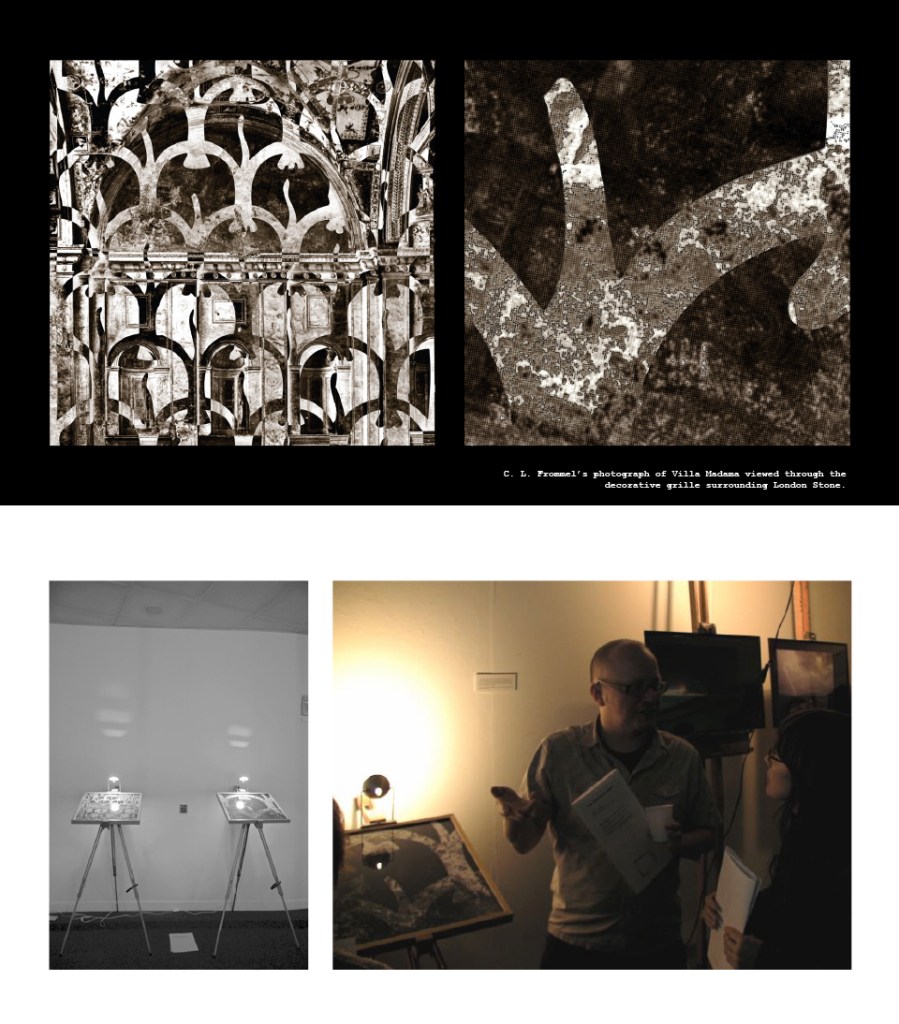
Figure 1. Alessandro Zambelli, The Decorative Frame exhibited at The View From Here ‘Research Spaces’ event, [first exhibition and exhibition at the BBC]. 2009. Photograph: Michiko Oki.
At around that time I was also making simple collages exploring interdisciplinary intersections with archaeological practice. This one (Figure 2) became a kind of touchstone for the subsequent direction my research and my practice took. You might recognise the grille which once protected (and interestingly obscured) London Stone, replacing the cartesian grid of the archaeological planning frame.

Figure 2. Alessandro Zambelli, London Stone grille used as a planning frame. 2008, Photomontage. Original image: Robert Van de Noort/Humber Wetlands Project. From: Kevin Greene, Archaeology: An Introduction, Fifth Edition, (London: Routledge, 2002). 116.
At one point I moonlighted in an archaeological illustration module at the Institute of Archaeology, UCL (the Institute very kindly allowed me to sit in, and Stuart Laidlaw whose module it was, crucially, allowed me to participate). These drawings (Figure 3) were ‘lightly’ hybrid architectural/archaeological, I would say, in the sense that although, for me, they seemed entirely archaeological – archaeologists nonetheless detected some hybridity – they were as I began to theorise, ‘undisciplined’.[2] These drawings were later incorporated into the ‘Jack and Becky’ undisciplined drawing mentioned below.

Figure 3. A selection of drawings made at an undergraduate illustration course module at the U.C.L. Institute of Archaeology
This phase of archaeological interdisciplinarity culminated in the moment recorded in Figure 4 below which I have also written about elsewhere. This ‘physically’ collaborative, pedagogical, drawing experience heightened the sense of undisciplinarity my research was taking. That is; being retaught an aspect of your own discipline you had already assumed an intimate, almost complete, acquaintance with.

Figure 4. Lesley McFadyen, Alessandro Zambelli with Lizzy Middleton at Must Farm.
Meanwhile what was beginning to emerge as a sustained interest in undisciplinarity, was tested this time in an anthropological context. As above, non-architectural participants were being asked to practice in architectural ‘mode’.
Having been invited to the University of Aberdeen to a seminar concerned with the parallel practices of anthropologists, architects and artists, I was asked to return to run one of a series of workshops intended to demonstrate to a range of social scientists the drawing practices of architects; one of a series developed to help them understand how they might profitably use those drawing practices, potentially, in their own discipline (as anthropologists had once used drawing as ethnographic techniques of recording). I haven’t posted about this workshop before, nor the extraordinary richness of these non-expert drawings produced in it (Figure 5), but so as not to clutter this post with too much detail about it I have made a new post especially about it here.
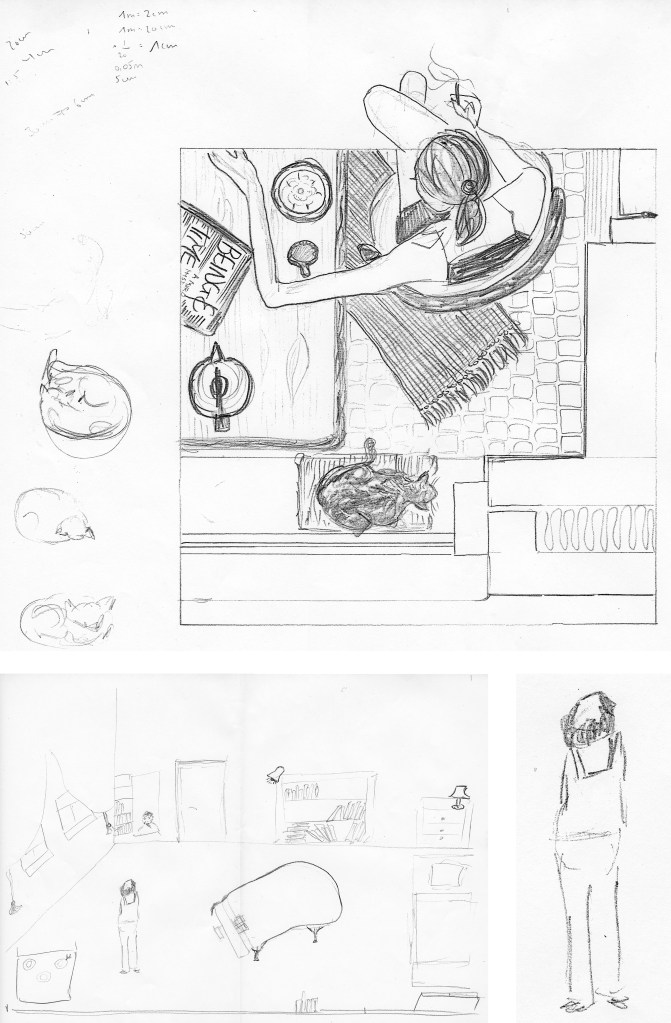
Figure 5. Fictional Space and Architectural Drawing: a workshop for social scientists at the University of Aberdeen.
Top: Participant 02, 02_02. Detailed drawing of ‘Miss Torso’s’ apartment, originally at 1:5. 2008, Photocopy, pencil on paper.
Bottom: Participant 01, 01_03. ‘Composer’s’ apartment in hybrid three-dimensional projection. 2008, Photocopy, pencil on paper and detail.
Other art practice interdisciplinarities were being tested too: critical walking/situated performances for example, this time using the ‘tour’ as a method, although forms of mapping and photography overlays were also used. This I have written about a number times; here for example although I show more of the overlays here (Figures 6–13) – these (mostly) show historic images of London Stone overlayed upon what was then the current building occupying that location.
There are also video stills (Figure 14) of some of the people accompanying me on the tour. Those who failed to avoid getting in the frame include: Jonathan Hill, Emma Cheatle, Jane Rendell, Belinda Mitchell, Barbara Penner and Ro Spankie. Eleanor Suess wielded the camera.

Figure 6. The Moves of London Stone tour [invitation].
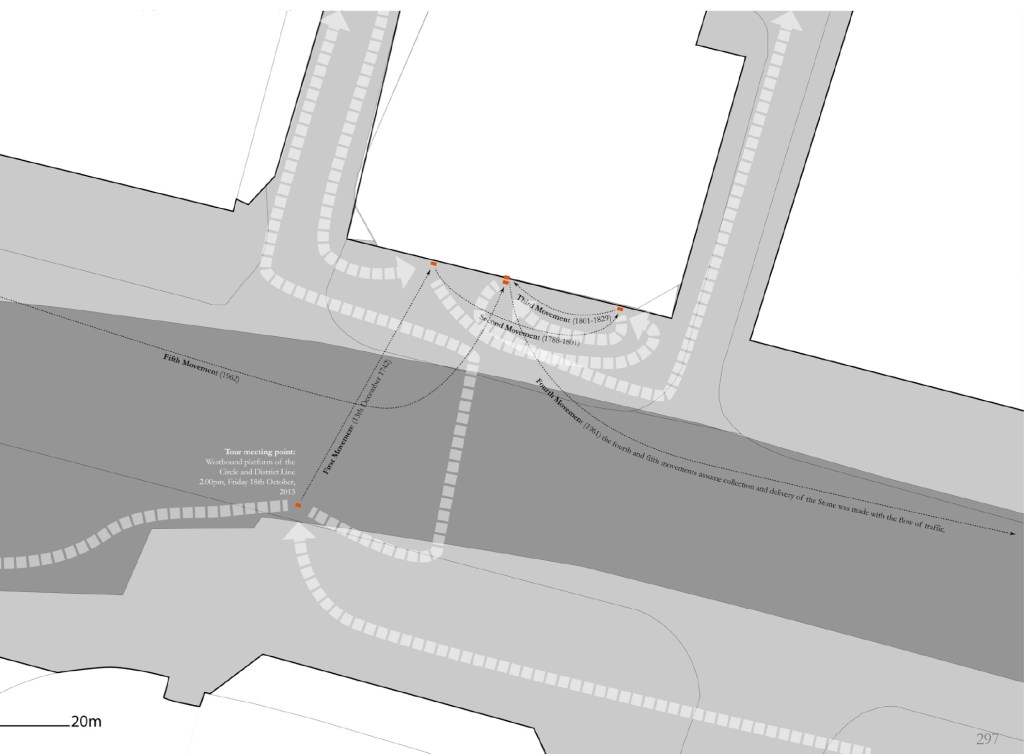
Figure 7. Tour route

Figure 8. Page from Tour booklet
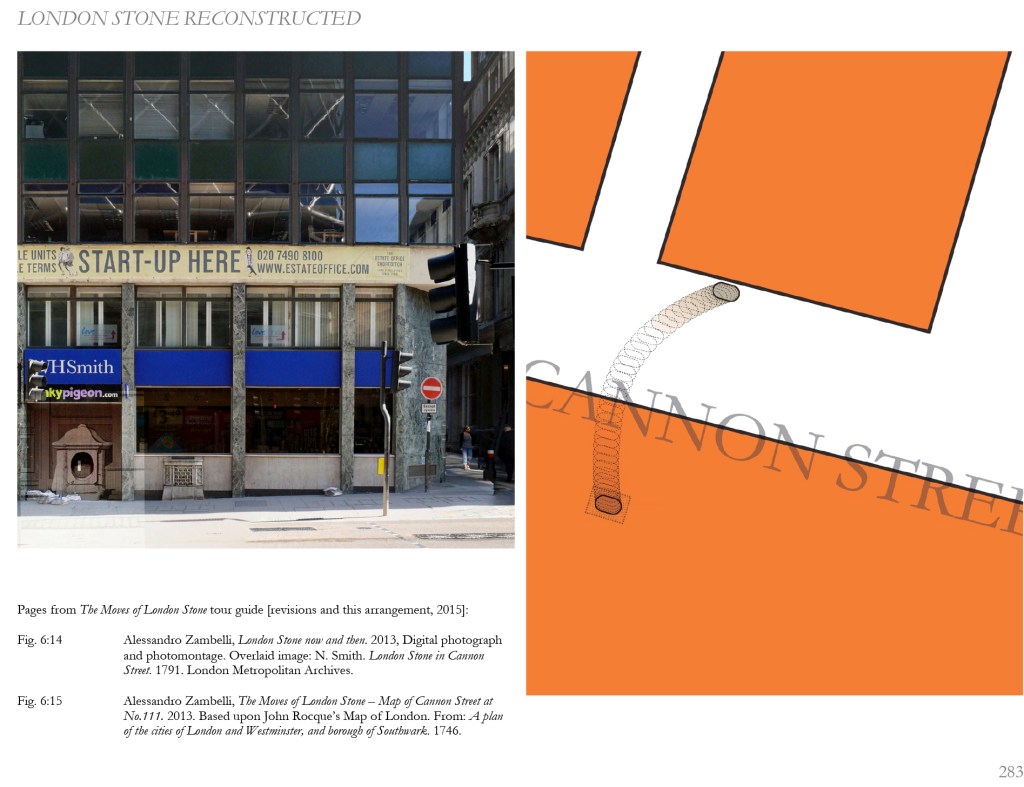
Figure 9. Page from Tour booklet

Figure 10. Page from Tour booklet

Figure 11. Page from Tour booklet

Figure 12. Page from Tour booklet

Figure 13. Page from Tour booklet

Figure 14. Eleanor Suess, The Moves of London Stone tour [stills from footage].
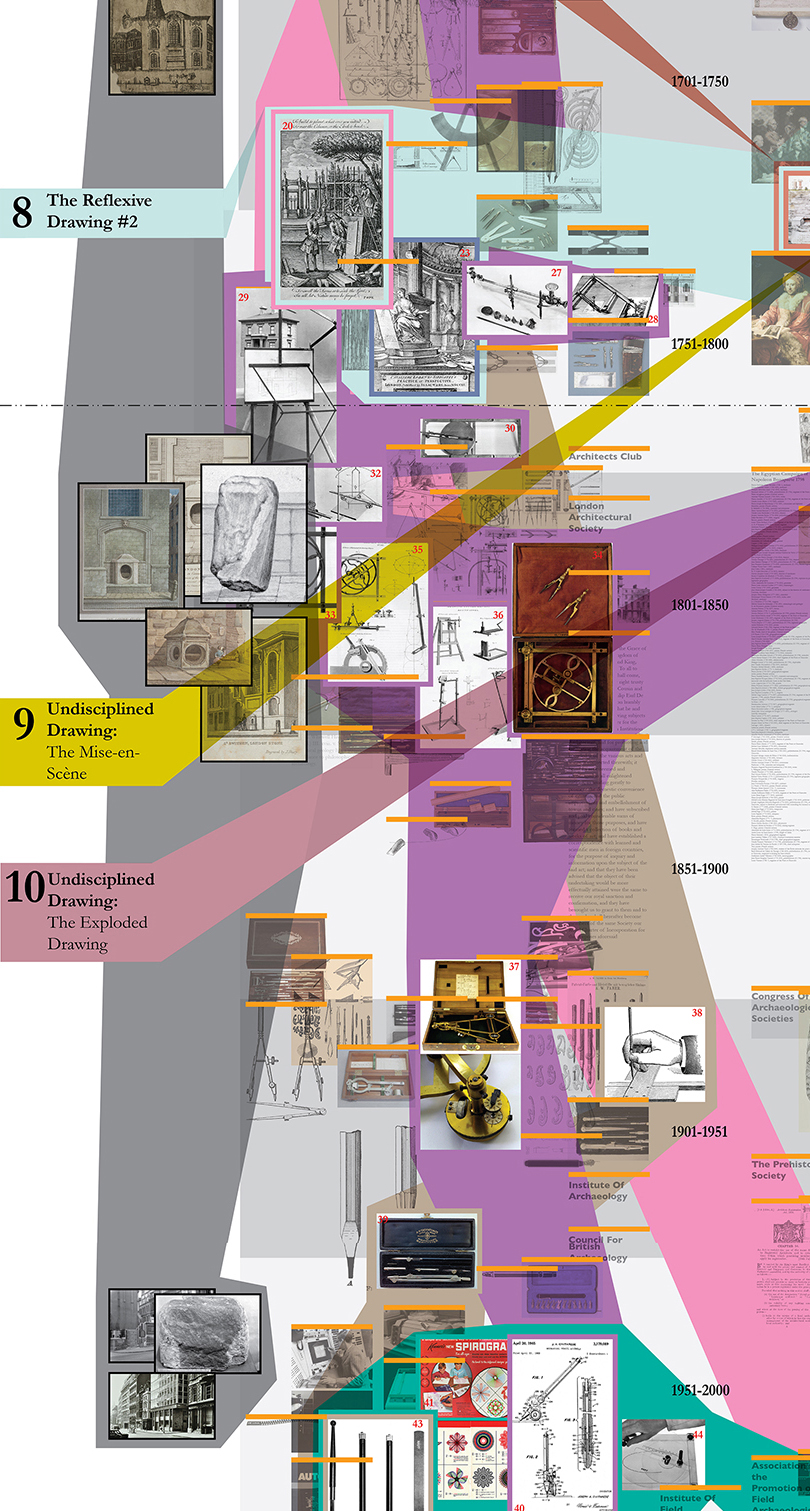
I was beginning research into undisciplined drawing in a much more systematic way, principally through diagramming methods which theorised a series of undisciplined drawing types tracible across time. This ‘Chronotopic Chart’ (Figures 15–16) suggested a number of undisciplined drawing categories and I was able to theorise in detail about the representational roles of a small number of these. I illustrate just one below (Figure 17), an example of the ‘exploded drawing’ type, because it is the one occasion when a drawing I produced whilst running my architectural practice, Bates Zambelli, appears in my research-orientated practice. I should probably do that more often!

Figure 15. Alessandro Zambelli, excerpts from Chronotopic Reconstruction (chart).
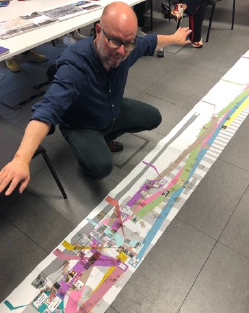
Figure 16.

Figure 17. Alessandro Zambelli, Balustrade Assembly Detail. 2005. Bates Zambelli Architects.
After making the transdisciplinary move away from architecture, strictly defined, ‘Drawing: A Materialist Definition’ (Figure 18) was a reflexive return to thinking about drawing per se. The text of the hand-drawn courier typeface is self-explanatory.

Figure 18. Drawing Tools: a materialist definition
Many of the undisciplinary drawing methods and types I had been working through were used to develop ‘The Return of Jack and Becky’ (Figure 19). A sort of meta drawing which became the locus for many other drawings or drawing fragments I had been working on in other contexts.
This is a drawing method I often employ and sometimes encourage students to use. The drawing becomes a kind of digital ‘site’ of collection or assembly for other drawings, some digital some manual. It is a ‘never-ending’ drawing which I have been working on for a number of years now. The other drawing in this category is a drawing I began during my Masters in the early 90s (Figure 20) and last amended in the mid 00s. I may well return to it (and Jack and Beck) again.

Figure 19. The Return of Jack and Beck: a propositional reconstruction.

Figure 20. The Garage of the Dead. 1992-ongoing
In a similar vein were the Metropolitan Salem drawings (Figures 21–22) I produced for Ben Judd’s exhibition at Liverpool’s Victoria Gallery and Museum.

Figure 21. Metropolitan Salem
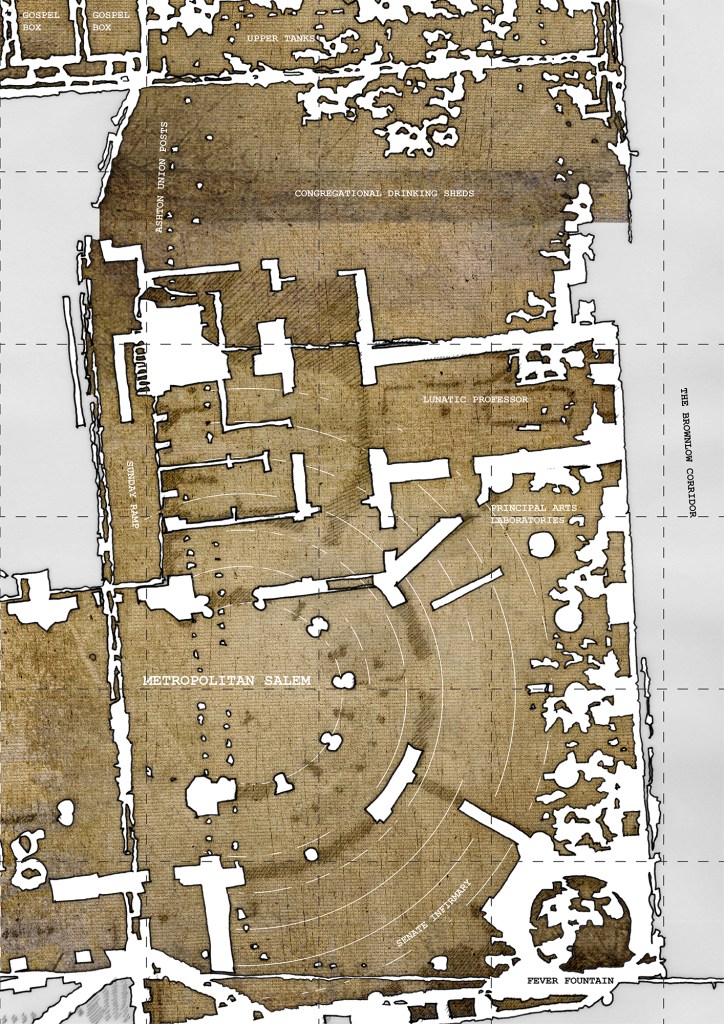
Figure 22. Metropolitan Salem
Back ‘in’ Archaeology I, and longstanding collaborator (and friend) Lesley McFadyen, invited other more or less likeminded colleagues to a TAG session we convened to discuss archaeological-architectural interdisciplinarities (Figure 23). I wrote about this in some detail here.
We reconvened as a group later, but by then the pandemic had intervened and afterwards my commons research was in full flow and seemed to sweep away everything in its path.
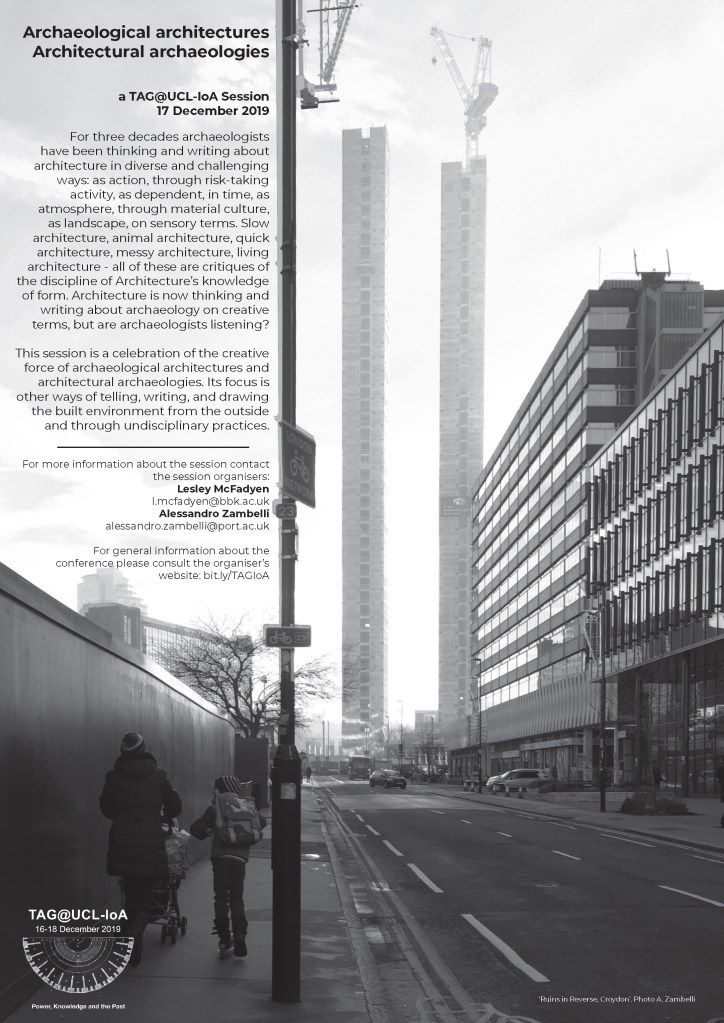
Figure 23 Archaeological architectures : Architectural archaeologies. A TAG@UCL-IoA Session.
This commons research described in many blogposts – here and here for example – seemed to be a very different kind of activity to the creative practice of interdisciplinary drawing I had otherwise been pursuing. However, pulling together the Wastes and Strays …on the Road exhibition last summer has caused me to rethink that hasty conclusion.
None of these are drawings produced by me, instead they are drawings made by others (Figure 24), some instigated by me, some under the direction of Siobhan O’Neill who worked with me as a post-doc on the project, most as co-creative community productions. But now I am beginning to read (some) of them as part of that strain of non-expert drawing I began looking at many years earlier.

Figure 24. Wastes and Strays. Work by University of Portsmouth students, Siobhan O’Neill and Valley Gardens, Brighton community participants.
It is this ‘extra’-disciplinary as well as undisciplinary drawing I am beginning to pick up again. And Australia-allowing will run with once more.
__________________________________________________________
Rodgers, Chris, Rachel Hammersley, Alessandro Zambelli, Emma Cheatle, John Wedgwood Clarke, Sarah Collins, Olivia Dee, and Siobhan O’Neill. English Urban Commons: The Past, Present and Future of Green Spaces. Routledge, 2023 [forthcoming].
Zambelli, Alessandro. “The Undisciplined Drawing.” Buildings 3, no. 2 (2013): 357-79. http://www.mdpi.com/2075-5309/3/2/357.
[1] Chris Rodgers et al., English Urban Commons: The Past, Present and Future of Green Spaces (Routledge, 2023 [forthcoming]).
[2] Alessandro Zambelli, “The Undisciplined Drawing,” Buildings 3, no. 2 (2013), http://www.mdpi.com/2075-5309/3/2/357.

 Scandalous Artefacts