

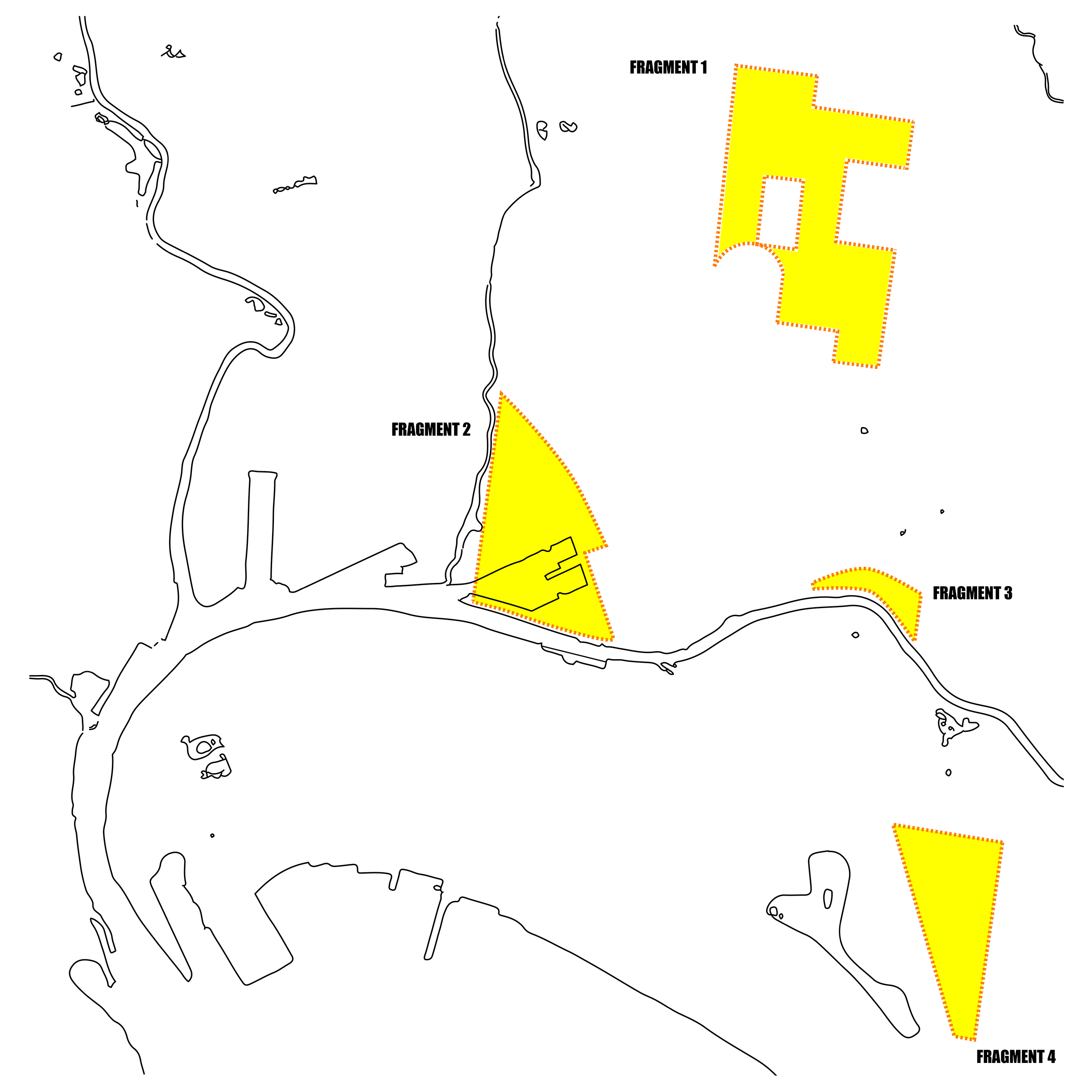
Not even the oldest inhabitant remembers where they were, but the Lands Department knows […][1]
This chapter, and the drawings, films, exhibition, and readings it describes, revisits the English practice of “beating the bounds,” a medieval ritual embedding embodied memory through collective and performative practice. A practice traditionally used to affirm parish boundaries – including those of common land – it is applied here as a means of re-remembering Australia’s lost commons.[1] We describe our reformulation of these traditions, using creative practice methods, aimed at revealing the lost commons of Melbourne: in exhibition format as part of “Repair Stories”; performatively as part of “The Book of Common Spells” in “The Festival of the Commons in Architectural Writing”[2] – and here in this text through the recapitulation of the “beatings” and the reincantation of boundary texts.

Figure 1. Beating the Bounds at Llantrisant, Rhondda Cynon Taf. Source: Llantrisant Town Trust.
Our second re-remembering became a summoning, and a dispelling, by recitation of names, through live performance (online in Australia, the UK and South Africa), overlaid as the films played.[3]
At the Repair Stories exhibition, the film was presented on two monitors set at right angles. With their differing durations, the two sequences formed an ever-changing diptych whose fragments paired and, when seen obliquely, mirrored and overlaid one another.
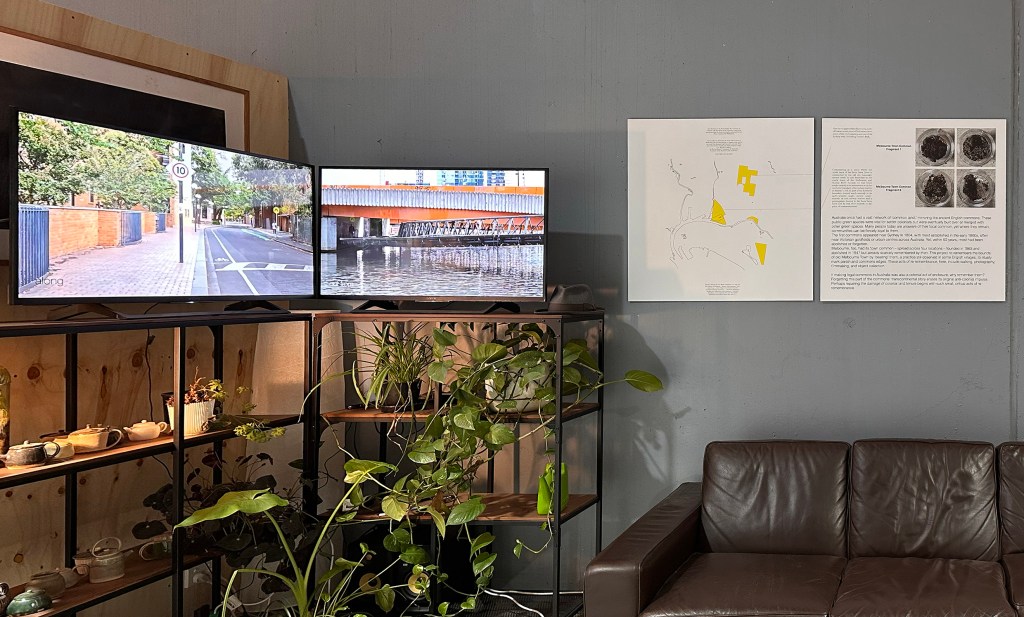
Figure 2. Eleanor Suess and Alessandro Zambelli. “Beating the Bounds of Melbourne Town Common [Panels and Film].” In Repair Stories [Exhibition], edited by Virginia Mannering, Kyla McFarlane, Nina Tory-Henderson, Hélène Frichot and Dylan Newell. Melbourne: Melbourne Design Week, 2025.
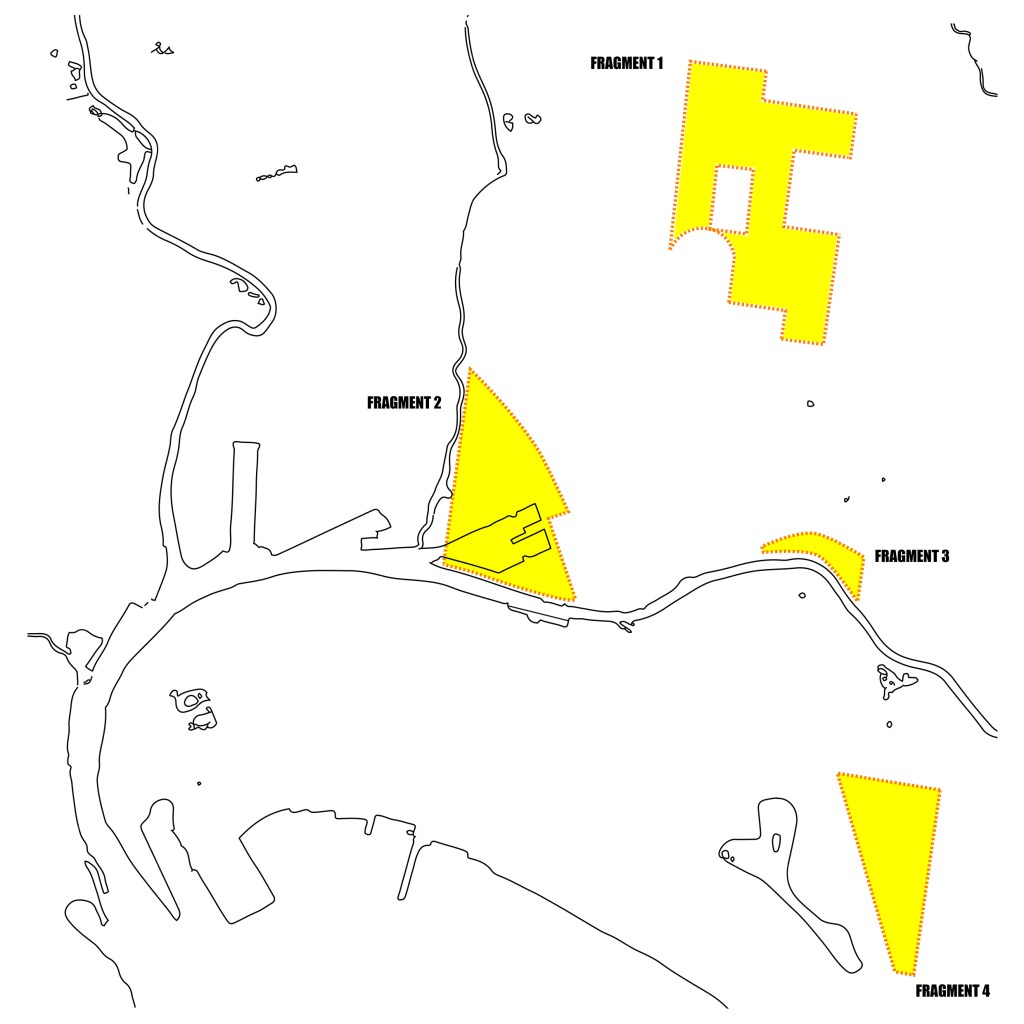
Figure 3. The 4 parts of Melbourne Town Common: Underlying map outline generated by Earth Resources – GeoVic © State of Victoria (Department of Energy, Environment and Climate Action). Retracing by Alessandro Zambelli.
1947
Mystery Solved Of Two More Commons
Not only has the mystery of Wandool—Ararat’s lost common—been cleared up […] but:
Today’s Government Gazette proclaims that the Governor (Sir Winston Dugan) has been pleased to abolish the Melbourne town common (proclaimed 1863) and the Hawthorn town common (1861).
Not, even the oldest inhabitant remembers where they were, but the Lands Department knows and says they have been abolished because It is realised they no longer include any unappropriated Crown land.[4]
1863
PROCLAMATION.
Now therefore I, Sir Henry Barkly the Governor of Victoria, with the advice of the Executive Council, do hereby proclaim the lands hereinafter mentioned to be a Town Common for Melbourne,
[…]
Area, one thousand and seven acres, more or less, being the unappropriated land embraced within the following described boundaries; Commencing at a point where the north bank of the Yarra Yarra River is intersected by the old city boundary; thence north by said boundary to the south fence of the Melbourne and Murray River Railway; by that fence south-easterly to its intersection with the northern boundary of the railway reserve at Batman’s Hill; by part of the northern boundary thereof south-westerly to its north-western angle; thence south-easterly by said railway reserve and a prolongation thereof to the Yarra Yarra River and by that river westerly to the point of commencement.
Given under my Hand and the Seal of the Colony, at Melbourne, this seventeenth day of August, in the year of our Lord One thousand eight hundred and sixty-three, and in the twenty-seventh year of Her Majesty’s reign.
(L.s.) HENRY BARKLY.
By His Excellency’s Command, R. HEALES,
President of the Board of Land and Works.
GOD THE SAVE QUEEN![5]
Birrarung, Yarra Yarra, Yarra
Coast Spinifex, Osaka, Chestnut Teal, North Wharf, Kangaroo Grass, Yarra, New Holland Honeyeater, Bolte, Red-fruit Saw-sedge, Citylink, Magpie-Lark, Docklands, Coastal Tussock Grass, Ron Barassi, Silver Gull, Moonee Ponds, Knobby Club-sedge, Pearl River, White-faced Heron, Observation, Common Reed, Footscray, Superb Fairywren, Old Timber, Sea Rush, Moonee Ponds, Little Wattlebird, Dynon, Water-ribbon, Anderson, Little Pied Cormorant, Ireland, Robust Water-milfoil, Railway, White Ibis, Dryburgh, Eel-grass, Adderley, Black Swan, Railway, River Red Gum, Abbotsford, Buff-banded Rail, Railway, Drooping She-oak, Madden, Boobook, Railway, Silver Mulga, Hawke, Pacific Black Duck, Railway, Silver Banksia, Roden, Great Cormorant, Railway, Round-Leaf Pigface, Stanley, Darter, Railway, Blackseed Glasswort, Rosslyn, Coot, Railway, Coast Spear-grass, Dudley, Little Black Cormorant, Adderley, Beaded Glasswort, Southern Cross, Nankeen Kestrel, Adderley, Grey Mangrove, La Trobe, Rainbow Lorikeet, Wurundjeri, Water-tassel, Marvel, Noisy Miner, Bourke, Swamp Paperbark, Batmans, Rufous Fantail, Fishplate, Yellow Box, Collins, Spotted Pardalote, Brentani, Showy Bossiaea, Batmans, Hobby, McCrae, golden wattle, Wurundjeri, Stubble Quail, Jim Stynes, Long-fruit Water-mat, Wurundjeri, Shining Bronze Cuckoo, Jim Stynes, Berry Saltbush, Webb, Willie Wagtail, Australian, Hop Goodenia, Seafarer, Little Raven, Adela, Plains Saltmarsh Grass, Tom Thumb, Great Crested Tern, Collins, Creeping Monkey-flower, North Wharf, Magpie, Victoria Harbour,
Yarra, Yarra Yarra, Birrarung[6]
[1] See for example: Amelia Soth, ““Beating the Bounds”: How did people find out where their local boundaries were before there were reliable maps?,” Cabinet of Curiosities 2023, no. 26 February (2020), https://daily.jstor.org/beating-the-bounds/; Steve Hindle, “Beating the Bounds of the Parish: Order, Memory and Identity in the English Local Community, c. 1500-1800,” in Defining community in early modern Europe, ed. M. Halvorson and K. Spierling (Ashgate, 2008); Eve Darian-Smith, “Beating the Bounds: Law, Identity, and Territory in the New Europe,” in Ethnography in Unstable Places, ed. J. Greenhouse Carol, Mertz Elizabeth, and B. Warren Kay (New York, USA: Duke University Press, 2002).
[2] Eleanor Suess and Alessandro Zambelli, “Beating the Bounds of Melbourne Town Common [panels and film],” in Repair Stories [exhibition], ed. Virginia Mannering et al. (Melbourne: Melbourne Design Week, 2025); Alessandro Zambelli and Eleanor Suess, “Dispelling the Unquiet Bounds of Australia’s Colonial Commons” (The Festival of the Commons in Architectural Writing, The Bartlett, UCL, 20th June 2025).
[3] Zambelli and Suess, “Short Dispelling the Unquiet Bounds of Australia’s Colonial Commons.”
[4] Upon the abolition of Hawthorn and Melbourne Town Common in 1947: “Mystery Solved Of Two More Commons.”
[5] Henry Barkly, Melbourne Town Common – Proclamation, (Melbourne: Victoria Government Gazette, 1863 [published 1915]).
[6] Italicised text was read by Eleanor Suess and non-italicised by Alessandro Zambelli: Zambelli and Suess, “Short Dispelling the Unquiet Bounds of Australia’s Colonial Commons.”

 Scandalous Artefacts