


Image: Eleanor Suess. Stills from ‘beating the bounds: Melbourne Town Common Fragment 1 and Fragment 2’, 2025
…and here are some fragments of something we, professor Eleanor Suess and I, did for the Festival of the Commons in Architectural Writing June 2025 at The Bartlett UCL. Our involvement was part of a jointly funded ABP University of Melbourne / Bartlett UCL commons and creative practice collaboration framework that I lead. Lidia Gasperoni is the Bartlett-side lead.
–/////////////////////////////////////////–

Slide 5 – modern kids
In last 20 or 30 years in England there has been the curious revival of this kind of thing.
Many of you will already know about the English practice of Beating the Bounds –
Slide 6 – omit
Amelia Soth describes its weird practices like this – I’m going to quota at length:
The practice was called “beating the bounds,” and the purpose was to create a shared mental map of the parish, to ensure that neighboring communities couldn’t encroach on their land. They carried flags, sang songs, read homilies, and used slender willow-branches to swat the landmarks that separated one parish from another.
It was the responsibility of the older members of the community to remember the boundaries, and the responsibility of the younger ones to learn them, so that they could be preserved for another generation. Pain was used as an aid to memory, and the form of attack was determined by the landscape. If they came to a stream, the children’s heads might be dunked in it; if the boundary ran against a wall, they might be encouraged to race along it, so that they would fall into the brambles on either side. If they came across a ditch, they might be encouraged to jump across it, so that they would slip in the mud. And when they came to a boundary-stone, the children would be flipped upside down, to have their heads knocked against it. In some spots, though, more pleasant memories would be created, by pausing for a glass of beer or a snack of bread and cheese. Finally, they would finish with a party on the village green.[1]
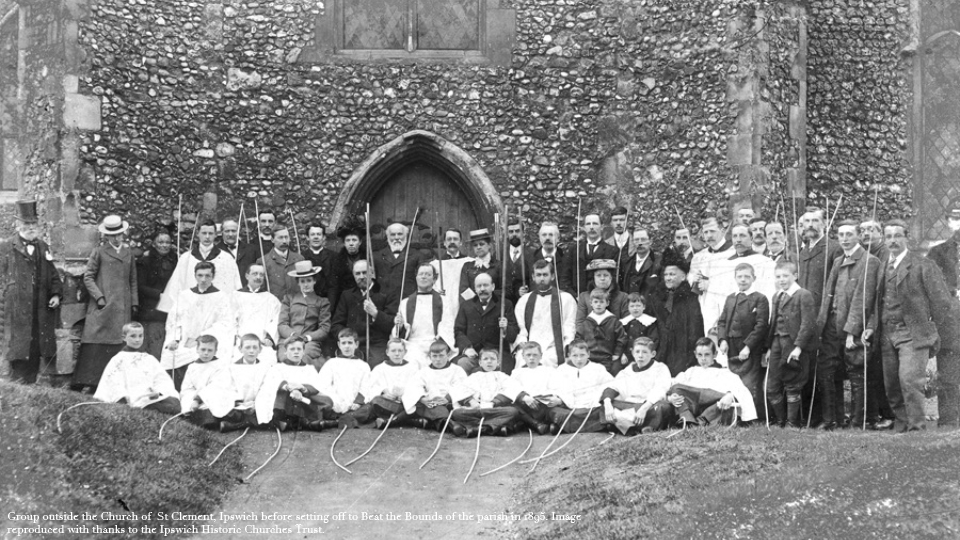
Slide 7 – 1895 parishioners
Steve Hindle sees a more spiritual – slash – folk-horror aspect to this:
“Their purpose [Hindle argues] was to expel from the community those evil spirits thought to be responsible for both contention and sickness; and to propitiate good weather. Those who processed behind the parish cross held aloft by the priest carried hand-bells and banners; chanted passages from the psalms and gospels; stopped at wayside crosses to say prayers for the crops; and sang the litany of the saints. Even in the late medieval period, however, this was not merely a ritual of incorporation, uniting the living and the dead through the authority of intercessory prayer. It also implied exclusion, for the demons which infested earth and air were banished by the objective power of holy words and gestures.”
Later on, Hindle continues:
“Stripped of its sacred associations, it was argued, the ritual was overwhelmed by processes of agrarian change, and especially by the obstruction of the traditional route around the boundaries which was often caused by the enclosure of open fields and common wastes.”[2]
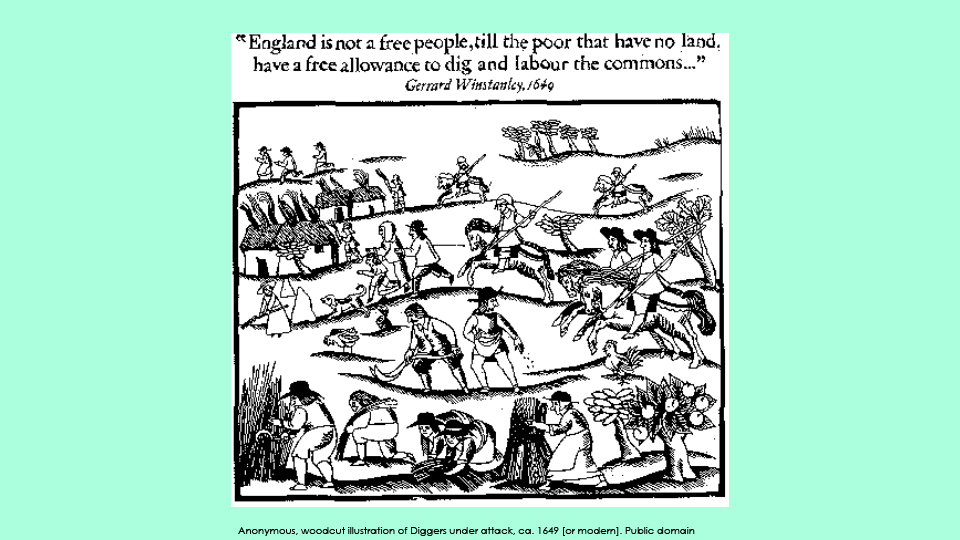
Slide 8 – Winstanley
Soth agrees:
The common lands that the people had once considered part of their shared landscape were fenced off and surrounded with hedges, and the practice of “beating the bounds” was slowly suffocated
Eve Darian–Smith argues that
,the revival of beating the bounds is one of many expressions of a popular anxiety about the need to preserve the landscape and, specifically, a communal right to public property. Beneath this ecological anxiety, however, runs the related but deeper concern in the English sensibility of identification with the land. This is linked historically to the loss of empire and more currently to the diminishing of Britain as a political and economic world leader.
Cut to Britian’s loss of its American colonies in the 18th century and the scrambled, often bungled attempt to find space for its ever-growing prison population in what became called Australia.
With the onset of colonial settlement came the imposition of English legal frameworks, including destructive structures of land ownership and management. One such structure, the institution of common land, had itself emerged in feudal England as a codified remnant of earlier Saxon practices—reconfigured following the Norman expropriation of land. When exported to the Australian colonies, the commons paradoxically became part of the colonial machinery of dispossession, enabling enclosure on a continental scale
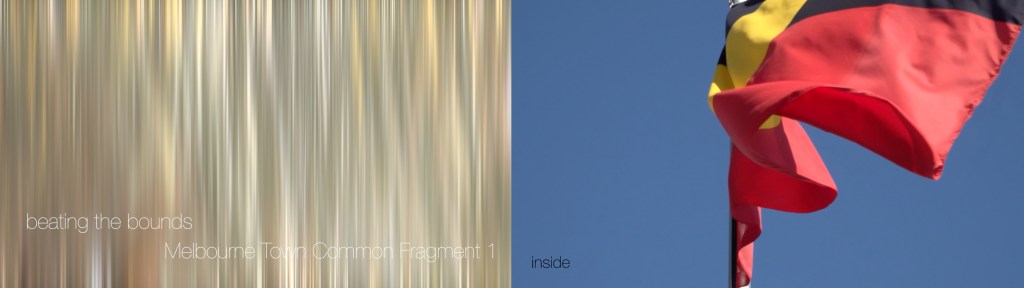
Eleanor Suess: stills from ‘beating the bounds’, 2025
Birrarung, Yarra Yarra, Yarra
Coast Spinifex, Osaka, Chestnut Teal, North Wharf, Kangaroo Grass, Yarra, New Holland Honeyeater, Bolte, Red-fruit Saw-sedge, Citylink, Magpie-Lark, Docklands, Coastal Tussock Grass, Ron Barassi, Silver Gull, Moonee Ponds, Knobby Club-sedge, Pearl River, White-faced Heron, Observation, Common Reed, Footscray, Superb Fairywren, Old Timber, Sea Rush, Moonee Ponds, Little Wattlebird, Dynon, Water-ribbon, Anderson, Little Pied Cormorant, Ireland, Robust Water-milfoil, Railway, White Ibis, Dryburgh, Eel-grass, Adderley, Black Swan, Railway, River Red Gum, Abbotsford, Buff-banded Rail, Railway, Drooping She-oak, Madden, Boobook, Railway, Silver Mulga, Hawke, Pacific Black Duck, Railway, Silver Banksia, Roden, Great Cormorant, Railway, Round-Leaf Pigface, Stanley, Darter, Railway, Blackseed Glasswort, Rosslyn, Coot, Railway, Coast Spear-grass, Dudley, Little Black Cormorant, Adderley, Beaded Glasswort, Southern Cross, Nankeen Kestrel, Adderley, Grey Mangrove, La Trobe, Rainbow Lorikeet, Wurundjeri, Water-tassel, Marvel, Noisy Miner, Bourke, Swamp Paperbark, Batmans, Rufous Fantail, Fishplate, Yellow Box, Collins, Spotted Pardalote, Brentani, Showy Bossiaea, Batmans, Hobby, McCrae, golden wattle, Wurundjeri, Stubble Quail, Jim Stynes, Long-fruit Water-mat, Wurundjeri, Shining Bronze Cuckoo, Jim Stynes, Berry Saltbush, Webb, Willie Wagtail, Australian, Hop Goodenia, Seafarer, Little Raven, Adela, Plains Saltmarsh Grass, Tom Thumb, Great Crested Tern, Collins, Creeping Monkey-flower, North Wharf, Magpie, Victoria Harbour,
Yarra, Yarra Yarra, Birrarung
14mins
[1] Amelia Soth, ““Beating the Bounds”: How did people find out where their local boundaries were before there were reliable maps?,” Cabinet of Curiosities 2023, no. 26 February (2020), https://daily.jstor.org/beating-the-bounds/.
[2] Steve Hindle, “Beating the Bounds of the Parish: Order, Memory and Identity in the English Local Community, c. 1500-1800,” in Defining community in early modern Europe, ed. M. Halvorson and K. Spierling (Ashgate, 2008).

 Scandalous Artefacts