

A series of commons-related things I’ve been up to in the last year or so:
– some pedagogical like this Masters design studio combining commons and hauntology….
–////////////////////////////////////////–

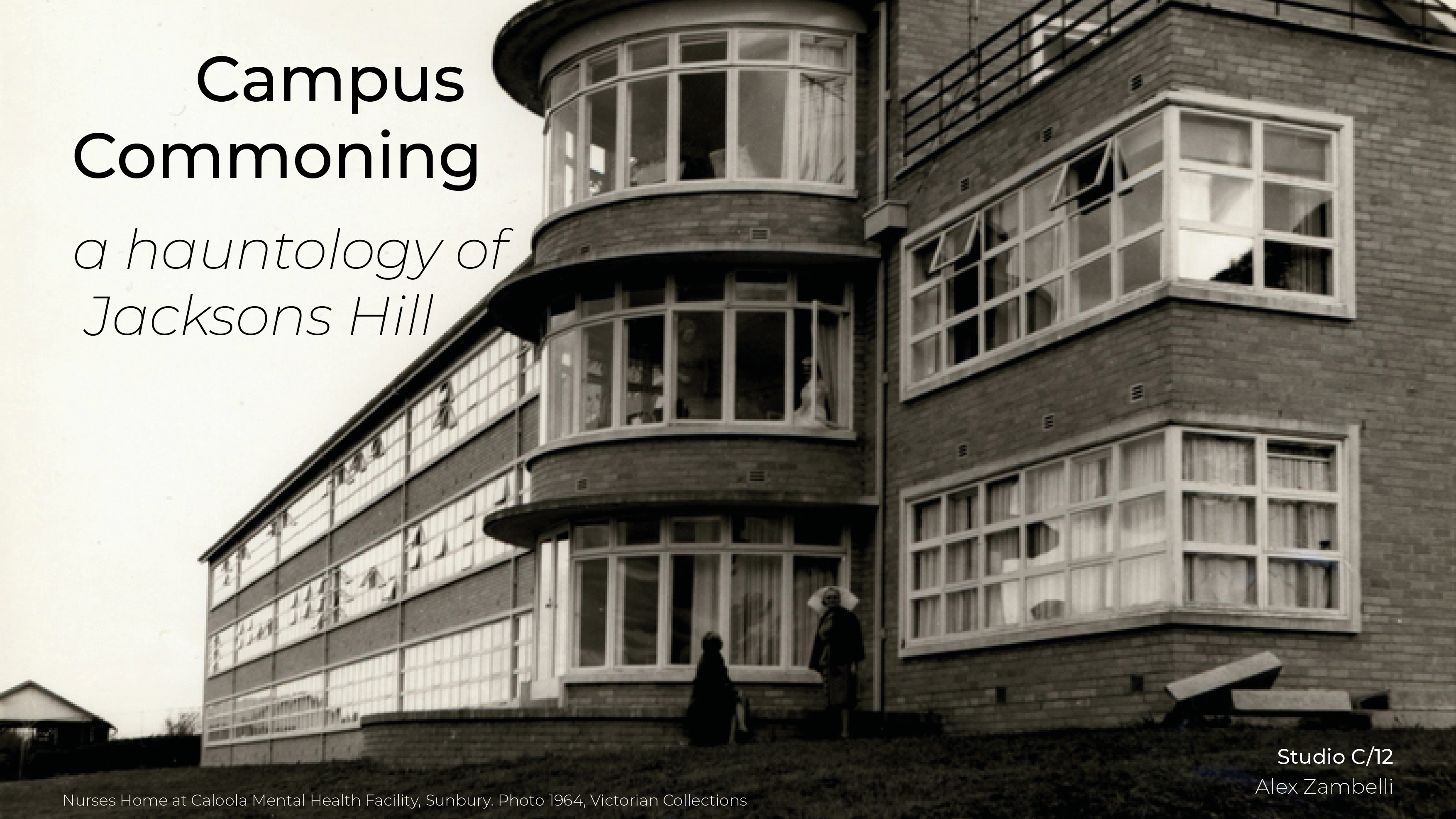
Campus Commoning: a hauntology of Jacksons Hill
I wrote:
Here amongst the layers of post-colonial architectures is an ancient landscape….
“Haunting can be seen as intrinsically resistant to the contraction and homogenization of time and space…
….It happens when a place is stained by time, or when a particular place becomes the site for an encounter with broken time.”
So wrote film critic Mark Fisher about Jacques Derrida’s notion of hauntology
Site
Our haunted site – haunted that is in the sense that Fisher means it – is on Jacksons Hill near Sunbury on the outskirts of Melbourne amongst the buildings and landscapes now called Caloola. Once the home of the Marin balug clan of the Woi wurrung people, it became an Industrial School and related educational farm complex for orphans, it later became a psychiatric hospital and later still a training centre for those caring for the mentally ill. Taken over by Victoria University it was then abandoned by them leaving on the site two primary schools, a community theatre and gallery building and a community radio station. The rest of the campus buildings remain empty awaiting their return as ….. what?

Hauntology and this studio aren’t about ghosts as the word might suggest – not quite – instead hauntology suggests that things – people, plants, landscapes, buildings, animals, ideas – always return, or that they, in some way, never fully disappear. The authors of Plants: past, present and future also remind us that, “… urban areas are Country […] many non-indigenous people perceive the cultural context of Country as ‘lost’ in urban areas. This is never the case. Country is always alive and always remembers.” For us in this studio this is as true for pre-colonial landscape as it for post-colonial buildings.
To really understand these simultaneously present yet seemingly irreconcilable world-views we will read place as palimpsests that is active layers of all that has gone before and all that will come to pass. In some places this co-presence can be more readily discerned than in others – Jacksons Hill is one such place
To themes of hauntology we will bring ideas of commoning. Commoning is typically understood as a set of practices designed to broaden the stakeholdership of place, especially to those who belong to that place and who have been displaced or disenfranchised from it.
Many see this stakeholdership as an expanded cosmos including the non- or more than human – we will argue in this studio that this idea might be expanded further to include those not even physically present; to those that have been, and to those that are yet to come – repairing and caring for place its peoples and its things ….caring for Country.
We will ask: how will we protect and encourage the reuse of architectures which live on at this site, as well as acknowledging those architectures which have long gone, whilst simultaneously preparing for the architectures yet to come?
You will design places to learn to repair and work with the buildings which already exist on site and beyond but which acknowledge the crucial role that new materials and technologies play in preparing for the future.
Your buildings will do two things really well; teach how to repair and care for the old and research the new.

 Scandalous Artefacts